Why Artificial Turf Gets So Hot — and How to Cool It Down
QUICK ANSWER: Artificial turf gets hot because plastic blades and infill soak up sunlight and have no way to cool themselves the way living grass does. University studies have measured synthetic surfaces from roughly 150°F up to about 200°F on hot, sunny days — far above the air temperature. You can bring it down with shade, lighter colors, cooling infills, and a quick hose-down, though watering only cools it for a few minutes before it climbs back.
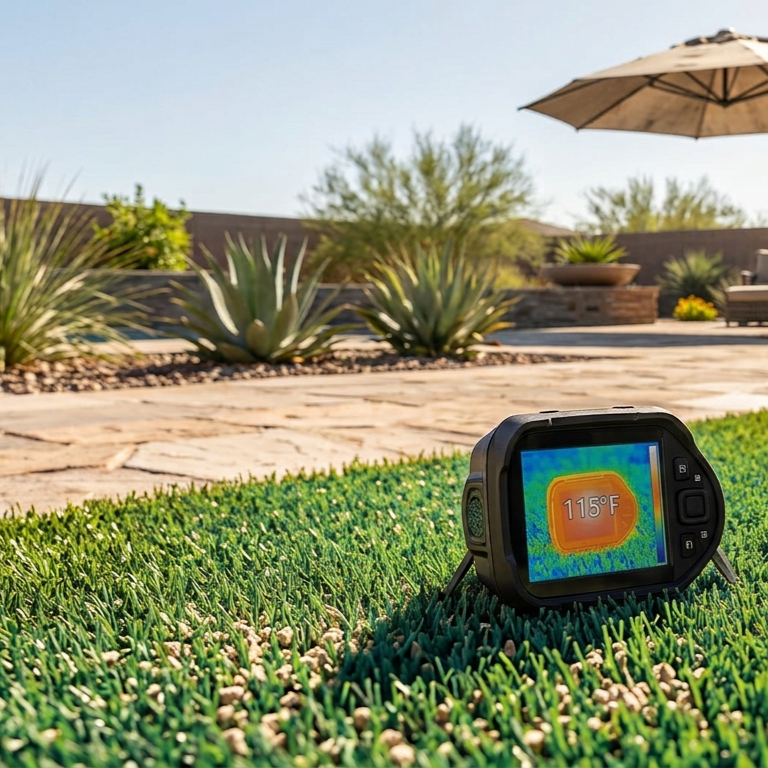
You step onto your turf barefoot on a July afternoon and immediately step back off. It looked like grass, but it sure didn't feel like it. Artificial turf has real advantages in the desert — no watering, no mowing, green year-round — but heat is its honest trade-off, and it catches a lot of homeowners off guard. Here's the why behind it, and what actually works to take the edge off.
Why It Gets So Much Hotter Than Grass
Living grass is a built-in air conditioner. It pulls water up from the soil and releases it through its blades, and that evaporation carries heat away — the same way sweat cools your skin. On a hot day, a natural lawn often sits near or even below the air temperature because of it.
Artificial turf can't do any of that. It's plastic blades sitting on a bed of infill, with no water to release. So every bit of sunlight that lands on it turns into heat with nowhere to go, and the dark fibers are especially good at absorbing solar radiation. The surface temperature climbs well past the air temperature and keeps climbing as long as the sun is on it. University researchers have measured synthetic turf reaching roughly 150°F to 200°F on hot, sunny days — one Brigham Young University study clocked a peak of 200°F on a 98°F afternoon, and Penn State recorded surfaces near 199°F. The heat also stores in the infill below the surface, which is why turf stays hot and rebounds quickly after you cool it.
The Infill Underneath Matters More Than People Think
Not all turf runs equally hot, and a big part of the difference is the infill — the granular material brushed down between the blades. The same Penn State testing found surface temperatures varying by 30 to 45 degrees between products on the same day, and the infill is a major reason.
Crumb rubber, the black recycled-tire infill, tends to run the hottest because it absorbs and holds heat. Silica sand runs cooler than rubber. And newer cooling infills — zeolite or coated, organic options like cork and coconut — are designed to hold moisture and release it slowly, mimicking a bit of the evaporative cooling grass gets for free. Manufacturers make strong cooling claims for these products, and while the exact degree varies, the underlying principle is sound: an infill that can hold a little water will run cooler than one that just bakes.
| Cooling method | How it works | How long it lasts |
|---|---|---|
| Hose it down | Evaporation pulls heat off the surface | Minutes — rebounds in 5-20 min |
| Shade (sails, trees, structures) | Blocks the sunlight before it lands | As long as the shade is there |
| Lighter turf and infill colors | Reflect more sun instead of absorbing it | Permanent, chosen at install |
| Cooling infill (zeolite, organic) | Holds moisture, releases it slowly | Longer than plain hosing |
What Actually Cools It Down
The fastest fix is also the most temporary: a quick spray from the hose. Water cools the surface immediately through evaporation — that BYU study dropped turf from 174°F to 85°F with irrigation — but it doesn't last. The same researchers watched it climb back to 120°F within five minutes and 164°F within twenty. So hosing is great right before the kids or dog go out, but it's not a set-and-forget solution.
For lasting relief, you have to plan for it. Shade is the most effective tool there is, because it stops the sunlight before it ever becomes heat — a shade sail, a pergola, or a well-placed tree over a play area changes everything. Choosing a lighter-colored turf and a reflective or cooling infill at installation brings the advantage permanently. And siting the turf so it gets afternoon shade, rather than full west-facing sun, makes a real difference in how usable it is in summer.
TIP: Before kids or pets go out on hot turf, do the five-second hand test: press your palm flat on the surface and hold it. If you can't keep it there comfortably for five seconds, it's too hot for bare feet or paws. At around 120°F, surfaces can cause skin injury in well under ten minutes.
A Word on Heat vs. Fading
It's worth separating two things people lump together. Surface heat is an immediate, daily comfort-and-safety issue — it's about how the turf feels right now. Fading is a slow, cosmetic process where intense UV gradually lightens the color over the years. Quality turf is built with UV stabilizers to resist fading, and that's a different question from how hot it gets on a given afternoon. A turf can be fade-resistant and still get hot, so when you're choosing a product, ask about both. The right turf and infill combination handles heat and holds its color, and for a pet area, especially, the heat side is worth getting right.
Frequently Asked Questions
Hotter than most people expect. University studies have measured synthetic turf surfaces from around 150°F up to about 200°F on hot, sunny days — one BYU study hit 200°F when the air was 98°F. That's well above asphalt and far above a natural lawn, because the turf has no way to cool itself through evaporation.
Yes, but only briefly. A hose-down cools the surface fast through evaporation, but testing shows it rebounds within minutes, back to over 120°F in about five minutes in one study. It's a useful trick right before someone uses the turf, not a lasting fix. Shade and cooler infills do more over the long run.
Crumb rubber tends to run hottest; silica sand is cooler; and purpose-built cooling infills like zeolite or organic options such as cork hold moisture and release it slowly to run cooler still. No infill makes turf as cool as grass, but the choice can shift surface temperature meaningfully. It's a decision best made at installation.
It can be. At surface temperatures around 120°F and up, brief contact can injure skin or paw pads. Always check the surface with your hand before letting kids or pets out — if you can't hold your palm on it for five seconds, it's too hot. Shade, cooling infill, and a hose-down before use all reduce the risk.
Quality turf is made with UV stabilizers that resist fading, so good products hold their color for years. Fading and heat are separate issues, though — turf can resist fading and still get hot in full sun. When choosing turf, it's worth asking about both UV resistance and heat performance.
Yes — shade is the single most effective way to keep turf cooler, because it blocks sunlight before it turns into heat. A shade sail, pergola, or tree over a play or pet area can keep the surface dramatically cooler than full sun. Planning the turf's location around afternoon shade pays off all summer.
Cool Turf Is a Choice You Make Up Front
Artificial turf gets hot because it can't sweat the way grass does — that's physics, not a defect. But how hot your turf gets and how usable it is in July come down to choices: the color, the infill, the shade, and the habit of a quick hose-down before use. Plan for the heat at installation and manage it day to day, and you get the low-maintenance lawn without the afternoon burn.
Planning turf that can take the desert sun? — Get the right blade color, cooling infill, and layout matched to your yard and how you'll use it. Turfscapes of Arizona LLC serves Phoenix and across Arizona. ROC #293110. Call (602) 884-8760.