What Goes Under Artificial Turf? The 6 Base Layers That Make It Last
QUICK ANSWER: Under artificial turf, from the bottom up, sits the excavated ground, usually a weed-barrier fabric, a few inches of compacted crushed-rock base graded to a slope, a fine screeded top layer, then the turf itself, and finally infill brushed down into the blades. The base is the crushed rock and the compaction; the infill is the sand in the blades. Those are two different jobs, and both matter.
Most people judge an artificial-turf installation by the part they can see: the blade color, the pile height, how green it looks the day the crew rolls it out. The part that actually decides whether it stays flat, drains after a storm, and still looks right in five years is the part nobody ever sees. A good install is mostly what sits UNDER the turf. The base is what makes it drain, keeps it level, and lets it last.
If you understand the layers, you can tell a careful install from a rushed one, and you can ask the right questions before a crew starts digging.
The Base Is the Whole Project, Not the Finish
A helpful way to size this up: the turf is the finished floor, and the base is the subfloor beneath it. You can lay the best flooring made, but if the subfloor under it is soft or out of level, every dip and bump reads straight through. Artificial turf works the same way. The roll of turf is a surprisingly small part of the labor and the material. Most of the work, and most of what separates a lasting install from a disappointing one, is the crushed rock and the compaction underneath.
That matters because the base controls two things the turf can't fix on its own: drainage and flatness. Water has to move somewhere after rain or after you rinse the yard, and the surface has to stay even so the turf doesn't telegraph every low spot. Get the base right, and the turf on top has an easy job. Get it wrong, and no quality of turf will save it.
Here is what goes down, in order.
Layer 1: Excavation
The crew removes the existing sod, dirt, and roots, usually to a depth of about 3 to 4 inches. This is not just clearing the surface. Living grass and organic soil hold moisture, shift as they dry and swell, and feed weeds, so they all have to come out. Excavating to a consistent depth also creates room for the base materials that replace them. Skip this, and you are building on shifting ground.
Layer 2: Weed Barrier/Geotextile Fabric
Many installs then roll out a geotextile weed-barrier fabric across the excavated ground. It pulls two jobs at once. First, it blocks light and slows weeds from pushing up through the base. Second, it separates the native soil below from the clean crushed rock above, so the two don't mix and muddy each other over time. It is optional on some jobs and standard on others, and for a yard prone to weeds, it earns its place.
Layer 3: The Aggregate Base
This is the heart of the install. The crew brings in a few inches of crushed rock, commonly a class II road base, decomposed granite, or a crushed miscellaneous base, and spreads it across the area. This aggregate base is what carries the load and moves the water.
Two steps make or break it:
Grading to slope. The base is not laid dead level. It is graded to a slight, deliberate slope so water has somewhere to go. Without that pitch, water sits.
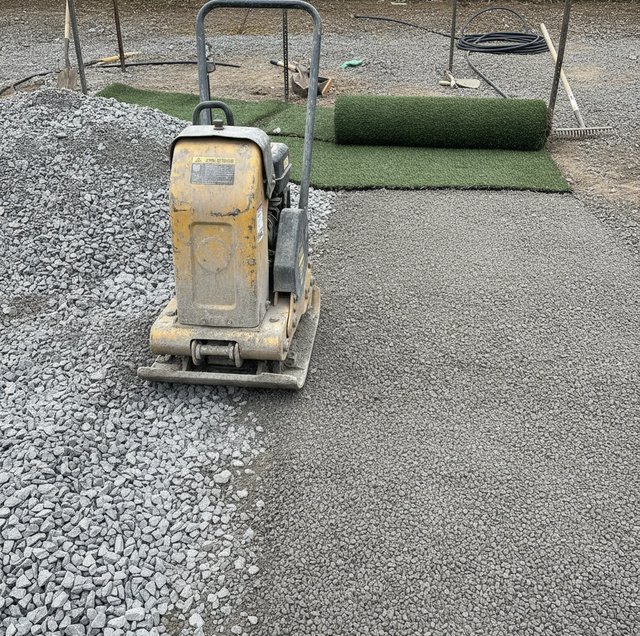
Compaction. The crew runs a plate compactor over the crushed rock, pressing it into a dense, locked surface. Loose rock shifts under foot traffic and settles unevenly. Compacted rock holds its shape. This is heavy, professional work with real equipment, and it is the single step most likely to be rushed on a cheap job.
Skipping or shortcutting compaction and slope is the most common reason a turf yard develops lumps, dips, and puddles later. The turf looked fine on day one because the problem was hidden below it.
Layer 4: The Fine Top Layer
On top of the compacted base goes a thinner, finer course, often a layer of decomposed granite or a fine bedding material, screeded smooth. The coarse base gives strength; this fine layer gives a tight, even surface for the turf to sit on. It fills the gaps between the larger rock, so seams lie flat, and infill settles evenly instead of disappearing into voids. A smooth bedding course is why a good install feels consistent underfoot instead of pebbly.
Layer 5: The Turf
Now the turf goes down. The rolls are positioned so the blades all lean in the same direction, trimmed to fit, and secured. Edges are pinned with turf nails or staples, and along borders, the crew often sets a bender board, a flexible edging strip that holds the perimeter clean and keeps the turf from creeping. Where two pieces meet, the seams are glued or seamed together so the join stays invisible and doesn't lift. The turf is the visible finish, but by this point, most of the real work is already buried under it.
Layer 6: Infill
The last step is infill, and it is a different job from the base. After the turf is laid, the crew brushes a granular material, usually silica sand or a coated sand, down into the blades. Infill does three things at once. It weights the turf so it stays put instead of shifting or rippling. It holds the blades upright so they don't mat down and go flat with traffic. And it helps water move down and off the surface. For pet areas, an antimicrobial or coated infill is often used to improve drainage and reduce odor.
Keep the roles straight. The base gives you drainage and flatness. The infill gives you upright blades and weight. The turf is the green surface you see. Three parts, three jobs. When someone says an installation "held up," they are usually describing the base and the infill doing their work, even though the turf gets the credit.
Why the Hidden Layers Decide Everything
Almost every problem people blame on cheap turf actually traces back to the base. Lumps and dips come from loose, poorly compacted rock. Standing water comes from a base that was laid flat instead of sloped. A yard that feels hard or hollow in spots comes from a bedding layer that was skipped or done thin. The turf on top is rarely the culprit.
For a dog run, the base choice matters even more. A pet area relies on a more permeable base and a coated or antimicrobial infill so that urine drains straight through and moves away rather than pooling. That is what cuts odor over time. It is the base and infill that make a dog area work, not a special turf.
None of this is exotic. It is careful excavation, the right crushed rock, an honest slope, real compaction, a smooth bedding layer, and the correct infill for how the yard will be used. Compaction and slope are the make-or-break steps. When they are done right, the turf on top has an easy life. When they are skipped, no turf can hide it for long.
Frequently Asked Questions
From the bottom up, it is the excavated ground, often a weed-barrier fabric, a few inches of compacted crushed-rock base graded to a slope, a fine screeded top layer, then the turf and its infill. One detail crews get right that homeowners rarely see: the base isn't dumped and pressed all at once. It goes down in lifts, a few inches of rock wetted and compacted, then the next few inches on top, so each layer locks solid before the one above it is added. That is what keeps a deeper base from settling unevenly later.
Installers typically excavate about 3 to 4 inches of existing sod and soil, then replace it with a compacted aggregate base. That depth gives enough crushed rock to carry water away and to hold a flat, stable surface underfoot. Too shallow and there isn't enough rock to drain or stay even; the three-to-four-inch range is the working standard for a residential yard.
A plate compactor presses the crushed rock into a dense, locked surface so it stops moving. The aim is roughly 90 percent compaction, and a simple field check is to walk the finished base: done right, your weight leaves no footprints in the rock. Wetting the base before compacting helps the fines settle and the rock lock together. Skip or rush the step, and the base stays loose, so the turf later develops lumps, dips, and low spots that hold water. Because it's buried, the problem doesn't show until months after the turf goes down.
Quality turf is astonishingly porous; its backing is punched with drainage holes that let it pass water on the order of dozens of inches per hour, far more than any storm delivers. So the turf rarely holds the water back; the base does the real work. The aggregate is permeable crushed rock graded to a slight pitch, usually around a couple of percent, and it's that slope that actually carries the water off to where it can leave. Lay the rock dead level, and the water simply sits beneath the turf rather than moving away.
Infill is the granular material, usually silica or coated sand, brushed down into the blades after the turf is laid. It's applied at roughly 1 to 2 pounds per square foot, depending on pile height, and a crew brushes it in and stands the blades back up in stages rather than one heavy pass, so it settles to the base evenly. It weights the turf so it stays put, holds the blades upright against foot traffic, and helps water move off the surface. Without it, turf tends to shift, ripple, and go matted.
A pet setup swaps in two specific things. For infill, a zeolite is used instead of plain sand: it's a mineral that absorbs and neutralizes the ammonia that makes urine smell, which standard sand does nothing to address. Underneath, a more permeable base, sometimes a dedicated drainage core, speeds rinse-through so a hose-down clears waste instead of leaving it to sit. Together they cut odor at the source, which is why the base and infill choice, not the turf itself, is what makes a dog area livable.
Get a base-first turf quote — so your yard drains right and stays flat for years. Turfscapes of Arizona LLC serves Phoenix and the rest of Arizona. ROC #293110. Call (602) 884-8760.