What Makes Turf Pet-Friendly? The 4 Features That Control Odor
QUICK ANSWER: Pet-friendly turf differs from standard turf in four ways: a fully permeable backing that lets urine pass straight through, an antimicrobial treatment that slows odor-causing bacteria, an infill that traps and neutralizes ammonia, and a permeable base that lets liquid drain and be flushed. Odor control comes from all four working together, plus routine rinsing, not from any one of them.
If you have watched a dog use the same patch of yard for a year, you know the problem pet owners are really trying to solve. It is rarely the mud or the bare spots. It is the smell that lingers after a hot afternoon, the yellow puddle that sits on the surface instead of soaking away, and the worry that whatever you install will trap all of that instead of moving it along. Artificial turf can handle a dog's daily routine, but only if the product and the layers underneath it are built for it. Standard turf and pet-rated turf can look nearly identical in a showroom sample. The difference is in how they handle liquid, how they handle the bacteria that the liquid feeds, and how the whole assembly is put together.
The short version: pet-friendly turf is a system, not a single feature. Drainage, backing, infill, and the base each do a specific job, and skipping any one of them shows up as odor within a few weeks. Here is how each part works and why the combination matters more than any single product claim.
Drainage Is the First Line of Defense
When a dog urinates on real grass, the liquid soaks into the soil and disperses. On turf, it has to pass through the backing and the base, or it sits on top. That is why drainage is the feature that separates pet turf from the rest.
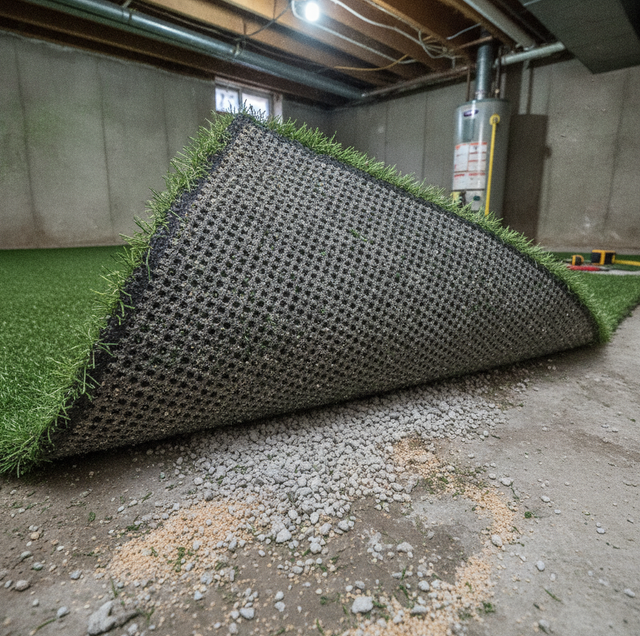
Most standard artificial grass uses a backing with drain holes punched through it at intervals, often spaced a few inches apart. That works fine for rainwater, which spreads across the surface and finds a hole eventually. Urine does not spread. It lands in a concentrated spot, and if that spot is between drain holes, the liquid pools and migrates sideways to the nearest opening. Slow drainage means the urine spends more time against the fibers and the infill, which is exactly where odor gets its start.
Pet-rated turf typically uses a fully permeable backing instead. Rather than a handful of punched holes, the entire backing is designed to flow through, sometimes described as a 100 percent permeable or fully-draining backing. Liquid passes straight down wherever the dog goes, so there is no pooling and no waiting for it to find an exit. That single change, from hole-punched to fully permeable, is the biggest reason a dog run built on pet turf drains faster than one built on a standard product.
Drainage rate is worth thinking of the way you would a shower drain. A drain the size of a coin in the middle of the floor works, but water has to travel to reach it. A floor that drains across its entire surface clears instantly, no matter where the water lands. A dog does not aim, so the fully permeable version keeps liquid from sitting.
The Backing Does More Than Hold the Blades Together
The backing is the layer that the grass fibers are stitched into, and on pet turf, it often carries a second job. Some pet-rated products include an antimicrobial additive built into the backing material to slow the bacteria that break urine down into the compounds you can smell. Odor is not really the urine itself. Fresh urine is close to odorless. The smell develops as bacteria act on it, and an antimicrobial backing is meant to make that surface a less hospitable place for those bacteria to multiply.
It helps to be clear about what this feature does. Manufacturers describe antimicrobial backings as inhibiting odor-causing bacteria, which is a reasonable way to put it: a treatment that slows a process, not a sterilizing layer that eliminates it. On its own, an antimicrobial backing will not keep a heavily used dog run fresh. It is one contribution to a system, and it works best paired with an infill and a rinsing habit that handles the part the backing cannot reach.
Infill Is Where Most of the Odor Battle Is Won
If drainage moves the liquid and the backing slows the bacteria, infill deals with what the liquid leaves behind. Infill is the granular material brushed down into the turf between the blades. It weighs the turf down, keeps the fibers upright, and in a pet application, it becomes the main tool for controlling ammonia.
Ammonia is the specific compound most responsible for that sharp dog-run smell. As urine breaks down, it releases ammonia, and where that ammonia ends up determines whether your yard smells. Plain silica sand, the standard infill for a general-purpose lawn, does not do anything to ammonia. It fills the space and holds the blades up, and the ammonia passes right by it.
Pet installations usually call for a different infill. Two common choices are an antimicrobial-coated sand and a zeolite infill. Zeolite is a naturally porous mineral whose structure captures ammonia molecules and holds them, neutralizing that part of the odor rather than letting it float off. Coated sands add an antimicrobial layer to the granule to work against the bacteria as well. Either way, the infill choice drives a large share of the final odor result, which is why two turf jobs using the same grass can smell completely different depending on what was brushed into them.
This is the point most people miss when they compare products by looking at the grass alone. The blades you can see are a smaller part of the odor equation than the granules you cannot.
The Base Beneath the Turf Matters as Much as the Turf
Turf does not sit on bare dirt. It sits on a base, usually a compacted layer of crushed aggregate, and for a dog, that base is doing real work. A permeable aggregate base lets liquid keep moving after it clears the backing, carrying it down and away from the surface where a nose would notice it. Some pet builds add a layer specifically meant to let liquid pass through and be flushed out later with a hose.
The failure mode is a base that holds moisture. If the ground underneath traps liquid, or drainage was never built into it, urine clears the turf only to sit in the base, where it feeds bacteria out of sight, and no amount of surface rinsing reaches it. You end up with a yard that smells worse the longer it is used, and the turf gets blamed for a problem the base created. A well-built pet base is the quiet half of odor control: done right, nobody thinks about it, and when it is skipped, it undoes everything above it.
Blades and Durability: The Digging and Matting Question
Beyond liquid, the other thing a dog does to turf is run on it, roll on it, and occasionally try to dig it. Pet turf tends to use durable, resilient blade shapes that spring back rather than lie flat, so the traffic lanes a dog wears do not turn into a permanently matted stripe the way a softer, purely decorative grass might.
Digging worries a lot of owners, and the reassuring part is how turf changes the equation. A dog digs to reach loose soil, and a properly installed turf takes that away. The grass is anchored, the seams are glued or nailed tight, and the base is compacted, so a dog paws at it, finds nothing to move, and usually loses interest. A truly determined digger can still test the edges, which is why the perimeter and seams need to be well secured, but in the middle of a good installation, there is simply nothing for a dog to get a claw into.
Living With Pet Turf in Extreme Heat
One factor specific to a hot, sunny climate deserves a plain answer: artificial turf gets warm in direct sun. On a bright afternoon, the surface can run hotter than the surrounding air, and a dog feels that through its paws, the way you would feel hot pavement. This is not a defect in pet turf; it is physics working on any dark surface in full sun, and it is two-sided across the year, warm in the long summer stretch, and comfortable through the mild months.
The practical answers are simple. A quick rinse with a hose brings the surface temperature down fast before letting a dog out at midday. Positioning the dog's turf area where it catches afternoon shade from the house, a wall, or a tree keeps it cooler than an area baking in open sun, and a shaded hardscape spot gives the dog a cool alternative during the hottest hours. None of these changes the turf itself; they just fit the routine to the weather, and the same rinse that cools the surface also keeps odor down.
Odor Control Is a System, Not a Product
The theme running through all of this is that no single feature keeps a dog area fresh. A fully permeable backing that drains beautifully, but still smells if the infill is plain silica. A zeolite infill still smells if it sits on a moisture-trapping base. An antimicrobial backing slows bacteria, but cannot neutralize the ammonia that the infill is supposed to capture. The four features are links in a chain, and the chain is only as good as its weakest part.
Maintenance is the fifth link and the one that is yours to keep up. Routine rinsing carries diluted urine down through the system the way rain would, and an occasional enzyme or turf-specific cleaner breaks down the residue plain water leaves behind before it can start to smell. Solids are handled the same way they would be on a lawn: picked up and disposed of, followed by a rinse of the spot. Done consistently, that routine takes a few minutes. Skipped for months, even the best build will eventually let you know.
That is the honest picture of pet-friendly turf: a set of choices, drainage, backing, infill, and base that work together, plus a light maintenance habit that keeps them working. Understand that, and you can tell a real pet installation from a standard product with a pet label stuck on it.
Frequently Asked Questions
A fully permeable pet backing drains on the order of 100 or more inches of liquid per hour across the whole sheet, far more than a hole-punched backing rated at a fraction of that. Because the flow rating applies to every square inch rather than a few scattered openings, repeated urine hitting one favorite spot passes straight down through the sheet instead of pooling and creeping sideways. That whole-surface capacity is what lets a heavily used spot clear as fast as the dog can fill it.
Zeolite infill traps ammonia within its porous structure, but each granule holds only a finite amount and eventually saturates, so it needs periodic recharging rather than replacement. A mild enzyme treatment or a diluted vinegar-and-water rinse, run through roughly seasonally in a heavy-use run, drives out what the zeolite is holding and reopens its pores to keep capturing more. Skip that recharge, and a run that started fresh will slowly climb back to smelling, because the mineral is full and has nowhere left to put the ammonia.
The vulnerable point on any install is the perimeter, not the middle, so a proper pet install anchors the edges with bender board or galvanized nails spaced every few inches and reinforces every seam with extra adhesive. A determined digger instinctively works an edge where it might find a lifting corner, which is exactly why that edge gets the reinforcement rather than the field. Locked down that way, the dog paws at a rigid boundary, finds no corner to pry, and moves on.
A pet base is usually a compacted layer of angular crushed rock, commonly quarter-inch minus, whose sharp faces lock together to form a firm surface while the gaps between stones still allow liquid to drain. Some builds run that over a permeable membrane that allows water to pass but prevents the dog from reaching the soil. That angular, low-fines mix is the opposite of a fines-heavy base, which packs into a near-solid layer that seals off drainage and traps odor underneath the turf.
Beyond the material itself, the amount is specified: a pet run is filled to a target weight of zeolite per square foot, brushed down into the blades so it sits at the base of the fibers where liquid reaches it. That infill settles and compacts with traffic and rinsing over the first months, dropping below the fibers, so it has to be topped up to hold the specified weight. Let it thin out, and the odor control thins with it, since there is less mineral in place to capture the ammonia.
Pick up solids promptly, rinse the area weekly, and run an enzyme cleaner through a heavy-use run about monthly, and steer clear of chlorine bleach for this job. Bleach can degrade the polyurethane backing and break down the infill coatings over repeated use, shortening the life of the parts doing the odor work. The enzyme cleaner does the opposite, digesting the organic residue left by a plain rinse without attacking the turf assembly.
Request a free estimate — get a pet-ready turf system built to drain, resist odors, and withstand a dog's daily routine. Turfscapes of Arizona LLC serves Phoenix and the rest of Arizona. ROC #293110. Call (602) 884-8760.