Artificial Turf vs. Natural Grass: The Real Tradeoff
Choosing between artificial turf and natural grass is really one decision dressed up as many: do you want to pay more at the start and less every week after, or less at the start and a bit forever? Almost every difference between the two surfaces traces back to that single split. Grass asks for a smaller opening outlay and then a steady stream of your time, water, and money. Turf asks for a larger installation cost once, then very little. Understanding that shape first makes the rest of the comparison easier to read.
Below is how the two stack up across the factors homeowners actually weigh, followed by where each one clearly wins and how a mixed yard can borrow the best of both.
QUICK ANSWER: Natural grass costs less upfront and feels cooler and more natural underfoot, but demands ongoing mowing, watering, and repair. Artificial turf costs more to install but nearly eliminates upkeep, stays green year-round, and holds up in shade and heavy traffic where grass thins out. The right choice depends on how much water, time, and money you want to spend after the first season.
Maintenance and Time
A living lawn is a standing chore list. Grass needs mowing through its growing months, plus watering, seasonal fertilizing, weeding, edging, and reseeding wherever it thins. Skip any of those for long and the lawn tells on you with bald patches, weeds, or uneven color. The work is not hard, but it is constant, and it does not pause for a busy month.
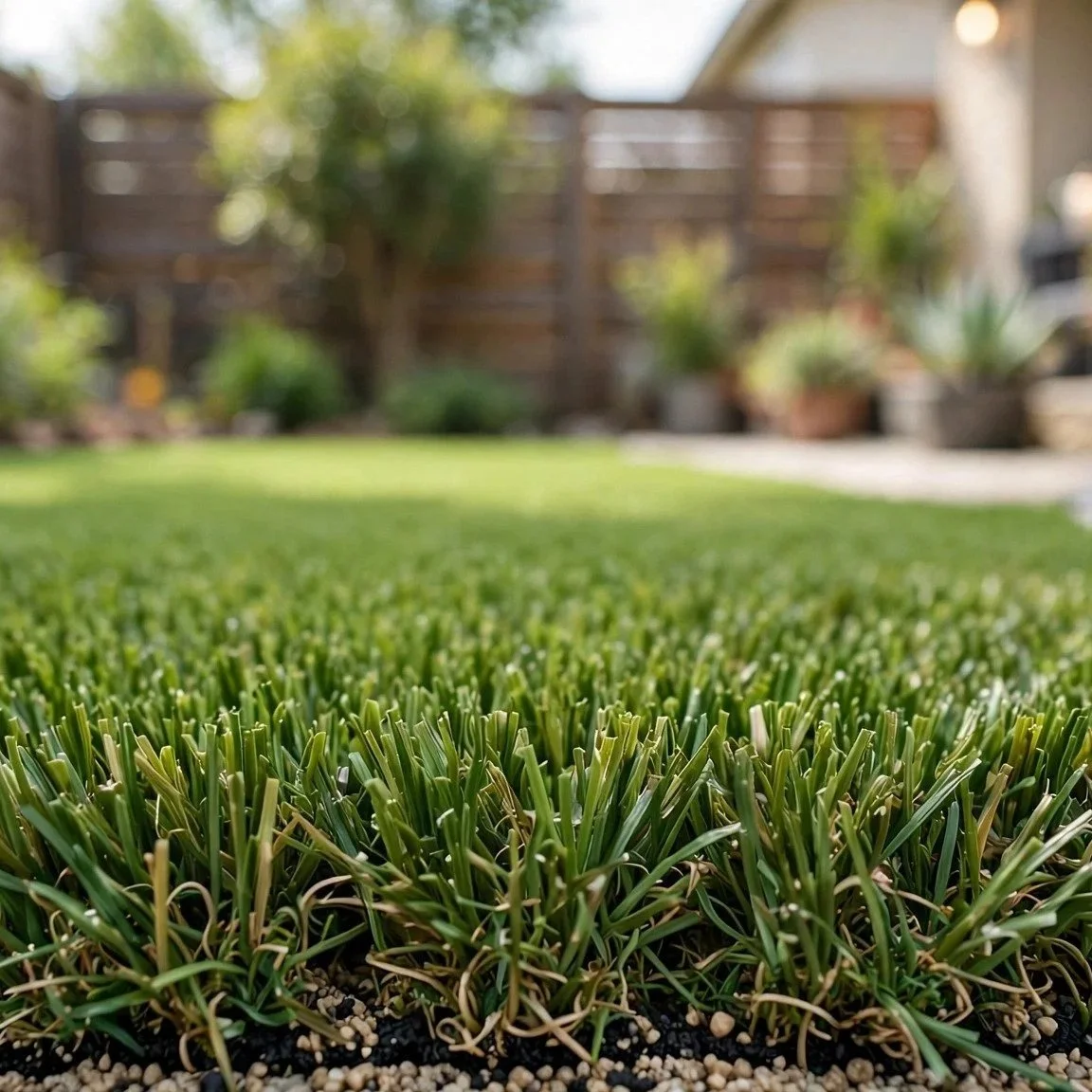
Turf inverts that. Once it is installed over a proper base, there is no mowing, no watering to grow it, no fertilizer, and no weeding of the surface itself. Upkeep shrinks to occasional tasks: a rinse to clear dust or pet waste, a brushing to stand the blades back up in high-traffic lanes, and a periodic top-up of infill as foot traffic works it down. That is closer to tidying than gardening.
Water Use
This is the factor that has shifted the most for homeowners. Natural grass is thirsty by design, and a healthy lawn draws a meaningful share of a household's outdoor water, more in dry stretches and during establishment. Where water is scarce, restricted, or simply expensive, that recurring draw is the lawn's highest long-run cost.
Turf needs no water to stay green. You may rinse it occasionally for cleanliness or, in strong sun, to cool the surface, but that is a fraction of what a lawn drinks. Framed evenly: grass carries an ongoing water demand year-round, while turf carries an occasional rinse. If cutting outdoor water use is a priority, turf answers it directly.
Cost Over Time
Here the upfront-versus-ongoing tradeoff shows plainly. Seeding or sodding a natural lawn is the cheaper way to get green quickly, so grass usually wins the opening cost. What follows is a running tab: water bills, mower fuel or a service, fertilizer, weed control, replacement seed, and your hours.
Turf reverses the shape. A quality installation, including base prep, drainage, the turf itself, and infill, is a larger single investment. After that, the recurring spend is small, mostly the occasional infill top-up and your rinsing time. Over enough years, the low ongoing cost narrows the gap, and in high-water or high-maintenance yards it can close it. Which surface is "cheaper" depends entirely on how far out you count.
Appearance and Comfort
Natural grass has a look and feel that is hard to fully copy: subtle variation in color, the give of living blades, and a scent after mowing. Underfoot, it also tends to run cooler than turf in direct sun, since living grass releases moisture as it warms. For homeowners who want the most natural sensory experience, real grass still leads.
Modern turf answers on consistency. It stays the same, even green every day, in every season, with no brown dormancy, no mud, and no mower stripes to keep up. The feel is uniform rather than varied. Its one comfort tradeoff is heat: turf can warm up in strong direct sun. A quick rinse cools it, a cooling-style infill helps, and blade quality matters, but it is a real factor to plan around for bare feet and pets.
The Heat and Water Point, Both Ways: It is fair to name both surfaces' weak spots side by side. Turf's is heat in full sun. Grass's is thirst, all year. Neither is a dealbreaker on its own, and both are manageable, but they pull in opposite directions: the surface that never needs watering is the one that can get warm, and the surface that stays cool is the one that keeps asking for water.
Durability, Shade, and Problem Areas
Grass is a living surface, which means it wears. Under a backyard's worth of running kids, a dog's regular path, or a shaded corner where sun never quite reaches, real grass thins, compacts, and turns to mud. Reseeding helps, but the same stressed spots tend to fail again. Shade and heavy traffic are where lawns disappoint most.
Turf is exactly where those trouble spots flip. It does not care about shade, it does not rut into a muddy track, and it takes constant traffic without thinning. A side yard the dog patrols, a play zone, a narrow strip between the house and fence, the ground beneath a shade tree: these are turf's home turf. Where grass struggles hardest, turf performs most reliably.
Pets and Kids
For pet owners, the daily reality matters more than the brochure. Grass can be dug up, worn into dirt trails, and yellowed by pet urine, and it holds mud that walks indoors. Turf resists digging, will not wear into bare tracks, and rinses clean. The catch is that a pet-friendly turf job depends on the base beneath it: proper drainage and, ideally, an odor-managing setup are what keep a pet area from pooling or smelling. Get the base right and turf is one of the easier pet surfaces to live with.
For kids, both surfaces work, with a familiar split. Grass gives a soft, cool play surface but shows the wear of a summer's play. Turf stays even and mud-free year-round, with heat the item to watch on the hottest afternoons.
Allergies and Lifespan
If grass pollen or lawn-care exposure bothers someone in the house, a living lawn keeps that trigger in the yard, while turf sidesteps the pollen and the fertilizers and weed treatments that come with grass. It is a quieter factor than water or cost, but for allergy-prone households it can be the deciding one.
On lifespan, a living lawn is effectively permanent if you keep feeding it the water and work it needs, since you are constantly regrowing it. A quality artificial turf installation is a long-lived product rather than a forever one: expect many years of service from a good system that is properly maintained, after which the turf is eventually replaced while the base often stays. The comparison, again, is ongoing effort versus a durable one-time asset.
Where Each One Wins
Natural grass is the better call when you want the coolest, most natural feel underfoot, when your opening budget matters more than your long-run spend, when water is plentiful and inexpensive where you live, and when you actually enjoy or don't mind the routine of lawn care.
Artificial turf is the better call when low maintenance is the goal, when cutting water use matters, for pet areas and busy play zones, and for the shaded or high-traffic problem spots where grass never establishes. If your yard has a corner that is perpetually mud or perpetually bald, that corner is turf's argument in one glance.
A Mixed Yard Is A Real Option: You do not have to pick one surface for the whole property. A common approach is turf in the tough zones, the dog run, the shady strip, the play area, the path that always ruts, and natural grass across the open, sunny stretches where a lawn thrives with less fuss. That hybrid gives you a cool natural expanse where grass earns its keep and a bulletproof surface where grass would only fail. Think of a yard the way you'd think of flooring: tile in the mudroom, wood in the living room, each material placed where it does its best work.
Getting The Install Right: Whichever way you lean, turf's performance lives or dies by what is underneath it. A compacted base and real drainage are what prevent pooling, mud, and odor, and grading the site is precise work, which is why base prep and installation are jobs for a pro rather than a weekend project.
WARNING: Turf can get warm in direct sun, and a reflective window or glass door can concentrate sunlight onto one spot and make it hotter still, so keep that in mind for pets and bare feet and rinse or shade as needed. Keep pool chemicals and lawn products off the turf, since those can stain or degrade the fibers.
Frequently Asked Questions
Yes, when it is built correctly. Quality turf backing is perforated, and the compacted aggregate base beneath it is graded to move water to a drain or a permeable edge. A pet-area system often adds an extra drainage layer above the base so urine flushes through rather than sitting. Poor drainage, not the turf itself, causes pooling and odor, which is why base prep determines how a lawn performs in heavy rain.
Living grass stays near air temperature because it releases moisture as it warms, a process turf cannot do. In strong direct sun, turf can read noticeably warmer than a grass lawn beside it. A 60-second rinse drops the surface temperature quickly for a while, and a lighter-colored or cooling-style infill reduces how hot it gets in the first place.
Not directly. Turf laid over living grass will trap moisture, invite pests, and settle unevenly as the grass dies underneath. The existing lawn is stripped, the soil is excavated a few inches, and a compacted aggregate base is built and graded before the turf goes down. Skipping that base is the single most common cause of turf that ripples, pools, or smells later.
Rarely, and never from the surface. A weed barrier fabric is installed under the base to block growth from below, so the only weeds you might see are wind-blown seeds that sprout in surface infill, which pull out by hand or wipe out with an occasional spot treatment. Compare that to a natural lawn, where weeding is a recurring season-long task.
For an average residential yard, infill is checked periodically and topped up every year or two, sooner in high-traffic lanes where footsteps push it down and displace it. Brushing the blades against the grain during a rinse redistributes infill and stands the fibers back up, which extends how long the existing infill keeps doing its job.
Quality turf with proper infill is not, because the infill gives the surface grip and the drainage clears standing water fast. The exception is a turf-covered hard edge, like a step or a pool coping strip, where a thin turf layer over a smooth surface can be slick. Those transition points are usually finished with a textured or non-turf material for footing.
Book a free on-site turf assessment — see exactly which zones of your yard turf or grass suits best. Turfscapes of Arizona serves Phoenix, Scottsdale, and the Valley. ROC #293110. Call (602) 884-8760.