Will Dogs Dig Up Artificial Turf? What Actually Fails
QUICK ANSWER: Most dogs do not damage a properly installed artificial lawn. There is no loose soil to dig into, and the turf is anchored at every edge and seam, so a dog has nothing to grab and nothing to reach. When turf does fail under a dog, it is almost always a poorly anchored install, not the dog.
If you have a digger at home and you are thinking about switching to artificial grass, the question is fair. You have watched this dog turn a natural lawn into a moonscape. Why would a plastic version fare any better? The answer comes down to how the lawn is built, not how motivated your dog is.
Why Loose Soil Is the Whole Problem
A dog digs a natural lawn because the reward is immediate. Under the grass is soft, cool, loose dirt that gives way under a paw. Every scratch produces a satisfying spray of earth, a cooler spot to lie in, or a step closer to whatever smell is buried down there. The behavior pays off, so it repeats.
A correctly installed artificial lawn removes that reward entirely. Under the turf is not soil. It is a compacted aggregate base, usually a graded rock product laid several inches deep, watered, and mechanically tamped until it is close to as firm as a walkway. A paw drawn across the surface finds no give. There is nothing to spray, nothing to move, and no cool loose pocket to reach. The dog scratches once, gets nothing, and moves on. The single biggest reason turf resists digging is that the compacted base makes the middle of the lawn a dead end.
Think of it like the difference between a sandbox and a tiled patio. A dog will happily dig a sandbox all afternoon because every push moves material. Ask that same dog to dig through a tiled patio, and the effort produces nothing, so the digging stops on its own. A good turf install turns the whole field into that patio.
What a Good Install Actually Does
The field being solid handles the middle of the lawn. The rest of a dog-resistant install is about closing off the only spots a determined dog could still get a grip.
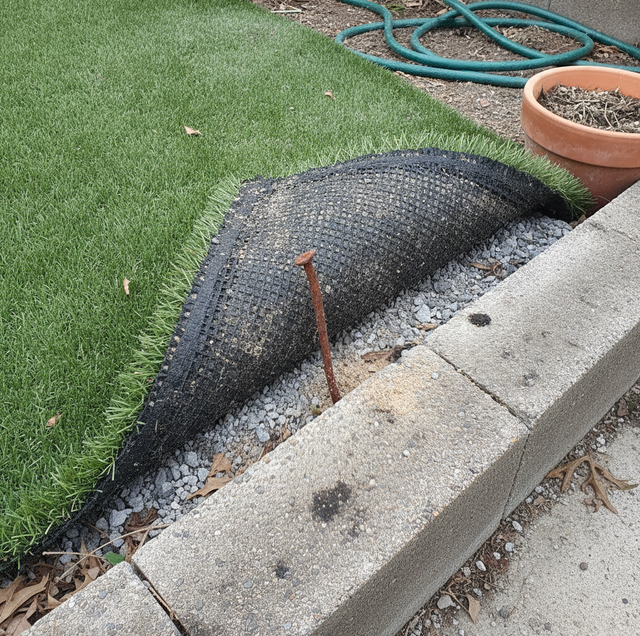
A locked-down perimeter: The edges of the turf are the first thing a dog can grab, so a quality install secures them hard. The perimeter is nailed or stapled at close intervals into the base, and the outside edges are often glued as well, running against a bender board or a solid hard edge that pins the turf down. Done right, there is no loose flap and no lifting corner for a claw to catch under. Whether a dog can start pulling turf up comes down almost entirely to this edge work.
Glued seams: Where two rolls of turf meet, they are joined with seaming tape and adhesive so the joint sits flat and bonded. A properly glued seam does not present a lip or a gap. A dog running its claws over it feels a continuous surface, not an edge to work at.
Durable blades and stitching: Pet-rated turf uses tougher yarn and denser stitching that holds the blades into the backing under repeated traffic and claw contact. Cheaper, thinner turf has a looser weave, and heavy claws can eventually pull fibers or thin a high-traffic path.
Infill and drainage: Infill is the granular material brushed down between the blades. It weighs the turf down, keeps the fibers standing upright, and works with the perforated backing and the free-draining base so urine and rain pass straight through instead of pooling. A firm, dry, odor-controlled surface gives a dog far less reason to fixate on any one spot.
What Can Actually Go Wrong
Turf failures under dogs are real, but they cluster around a short list of causes, and nearly all of them trace back to the install rather than the animal.
A lifting edge or corner: If the perimeter was under-nailed or never glued, a determined dog can catch the lifting edge and start peeling. This is the classic failure, and it is an anchoring problem.
A spot that smells: A dog will dig with real purpose at one specific place if something under or on the turf is drawing it. A urine-soaked patch that never got rinsed, a scent buried during install, or a critter that has tunneled in under the base will all pull a dog to that exact spot.
A worked-open seam: A seam that was taped but poorly glued can present a small lip, and a dog that finds it may work it wider over time.
Cheap, thin turf: Heavy claws on a low-density, thin-backed product can pull blades and wear a bare track along a favorite running lane.
Chewing: This is mostly a puppy issue during teething, and it targets loose edges and stray blades rather than the anchored field.
Notice the pattern. A dog almost never attacks the middle of the lawn, because the compacted base gives it nothing. It goes after edges and seams, which is exactly why a well-anchored install is so much harder for a dog to damage than a natural lawn ever was.
The Well-Built Lawn Versus the Cheap One
Two artificial lawns can look identical the day they are laid and behave nothing alike a year later with a dog on them.
The well-built lawn has a deep, compacted base, a perimeter that is nailed at tight intervals and glued against a solid edge, seams bonded flat, pet-rated turf with dense stitching, and the right infill brushed in. A dog investigates it, finds no reward, and treats it as ground rather than a project. This lawn is effectively dog-proof.
The cheap lawn was laid fast over a shallow or poorly compacted base, with the edges tacked down loosely, seams taped but barely glued, and a thin, low-density turf to hit a price. It gives a dog a soft spot here, a lifting corner there, a seam that peels. This lawn is a digger's target, and no dog training will fully fix what the installation got wrong.
The dog is the same in both yards. The outcome is decided by how the lawn was built.
Keeping a Turf Lawn Dog-Proof
Keep the edges and seams tight: These are the only places a dog can get a grip, so they are the things to inspect. Any early lift gets re-secured before it becomes a handle.
Keep it clean: Odor is a digging trigger, so rinse pet areas regularly and let the drainage and infill do their job of moving waste through instead of letting it sit.
Redirect a digger: A dog that has learned to dig elsewhere may test a new lawn. Interrupt and redirect early, before a spot becomes a habit.
Choose durable, pet-rated turf: Density and backing strength are what stand up to claws over the years, so the product choice matters as much as the install.
Repair promptly: A small lifted seam or torn edge only spreads if you leave it. Caught early, it is a quick fix, not a redo.
A hot climate adds one wrinkle worth naming. Turf gets hot in direct summer sun, and the surface can climb well above air temperature in the middle of the day. Dogs generally still choose to lie on it, especially in shade or after a rinse, and the heat has no bearing on whether a dog digs. It is a comfort-and-timing consideration for walks and midday play, not a durability one.
Frequently Asked Questions
At the edges and the seams, almost never the middle. The perimeter is fastened with galvanized spikes or turf nails set roughly every 4 to 6 inches, and once those edges are locked, there is no flap for a claw to catch. A proper install gives a digger nothing at the border, so a curious paw drawn along the outside runs into a pinned edge instead of a lifting corner. That fastener spacing is close enough that no gap opens up between nails for a claw to work into. The result is that the only tempting spots on a natural lawn simply are not there anymore.
A single fixation spot almost always means a scent is anchoring the dog there. An enzymatic pet-turf cleaner breaks down the urine odor that keeps drawing a dog back, which handles the most common cue. Where burrowing critters are a concern, a gopher-wire layer under the base blocks them from surfacing and tempting the dog with movement or fresh smell below. Treating the scent and screening out the tunnelers removes the reason for the fixation, rather than fighting the behavior at the surface.
Teething is the real risk window, and it usually runs until about six to eight months. During that stretch, a bitter-deterrent spray on a stray edge, plus keeping the blades trimmed flush, removes the loose bits that a puppy would nip at in the first place. Once the pup is past teething the interest fades on its own. Handled with a deterrent and a flush trim, most puppies leave the anchored field alone and grow out of the chewing without marking the lawn.
Beyond the nails, the seams are joined with seam tape and turf adhesive, and the outer edge is often set into a shallow trench or a bender-board frame. That means the whole perimeter is bonded into place rather than just laid down, so it holds as one piece instead of a series of loose flaps. A dog pawing the border feels a continuous bonded surface with no handle to exploit. It is the combination of fasteners, adhesive, and a captured edge that separates a lawn that stays put from one that peels.
Yes, and the method matters. Rinsing pet areas weekly and using a zeolite infill, which traps the ammonia given off by urine, keeps the odor cue from ever building up. When the smell that would start a dog scratching never develops, the trigger for that behavior is gone before it forms. This is less about appearance and more about denying a dog the scent that would make one spot worth returning to.
Yes. A lifted seam or a torn edge is re-glued or re-secured back into the base, and if a section has actually worn through, a patch of matching turf is cut and seamed into that area. A single damaged spot does not mean replacing the whole lawn. Because turf is installed in sections and joined, an isolated repair blends into the surrounding field once it is bonded and brushed back in.
Book a free turf assessment — see how a properly anchored install stands up to your dog. Turfscapes of Arizona LLC serves Phoenix and across Arizona. ROC #293110. Call (602) 884-8760.