
Home Putting Green Cups and Layout: How Many You Need
QUICK ANSWER: The number of cups a home putting green can hold depends on its square footage and shape. A small green often carries one to two cups; a mid-size or larger green comfortably holds four to six or more. The goal is not to cram in holes but to space them so you get short, medium, and long putts from several directions without lines overlapping.
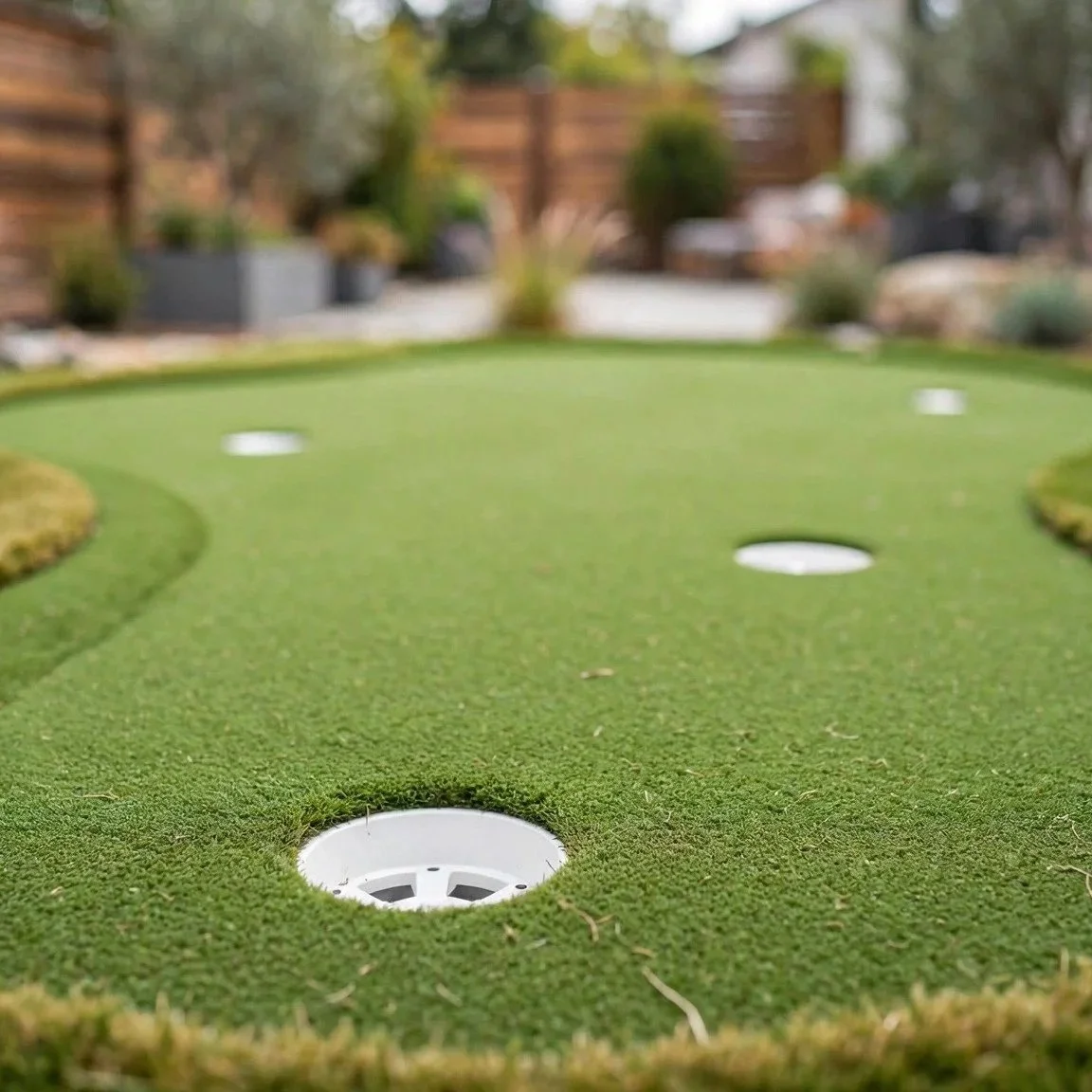
How Green Size Drives Cup Count
Before you decide where a single cup goes, it helps to see why size and shape set the ceiling on how many you can use well. A putting green is really a collection of putting lines, and every cup you add multiplies the lines available from the surrounding surface. Two cups on a rectangle give you a handful of useful putts. Four cups on a kidney-shaped green with a rise in the middle can produce dozens, because each cup can be approached from many spots and each spot presents a different distance and break.
Square footage is the first limit. A compact green in the 100 to 200 square foot range usually plays best with one or two cups, because the surface is not deep enough to give a full-length putt to more than a couple of targets. Step up to the 250 to 450 square foot range and four cups start to make sense. Past that, six or more cups become practical, and you can begin dividing the green into zones that each read differently.
Shape matters as much as raw area. A long, narrow green favors cups strung along its length so you can practice lag putting from one end to the other. A wide, curving green favors cups tucked into separate lobes, so a putt to one hole crosses different ground than a putt to its neighbor. The more the perimeter bends, the more approach angles each cup earns.
More cups plus contour equals more shots: A flat green with four cups gives you four straight putts of varying length. Add a gentle ridge or a low swale and those same four cups suddenly demand reading break, feeling uphill and downhill pace, and starting the ball off-line to let it curl back. Contour is the multiplier. It turns a fixed number of holes into a far larger menu of shots, which is the real reason a thoughtfully shaped green stays interesting for years.
Laying Out the Cups
Once the size sets your cup budget, placement is about separation and variety.
Spacing so putts do not overlap: Keep cups far enough apart that a putt rolling toward one hole does not track straight over another. A useful habit is to imagine the full-length line to each cup and check that those lines do not stack on top of each other. Cups set too close create a cluttered green where balls and flags get in each other's way, and few putts feel distinct. Give each hole its own corridor.
Building in short, medium, and long lines: Aim for a spread of distances. Place at least one cup where you can drop a three- to five-foot knee-knocker, one in the medium range, and one that lets you roll a genuine lag putt across most of the green. If every cup sits the same distance from the fringe, you end up rehearsing one length over and over. Variety in distance is what makes a home green train your full range.
Adding break and a collar: A putting surface with a little movement in it teaches far more than a table-flat one. Work in a subtle rise, a shallow valley, or a tilt across one corner so some cups play uphill, some downhill, and some with side break. Ring the putting surface with a fringe or collar of slightly longer turf. The collar frames the green, catches balls that run long, and gives you a defined edge to chip toward.
TIP: When placing cups, imagine the full-length putting line to each hole and check that those lines do not stack on top of each other. Cups set too close create a cluttered green where balls and flags get in each other's way, so give each hole its own corridor.
Chipping, Hardware, and What Sits Underneath
Chipping from the surrounding turf: If space allows, leave a band of longer play turf around the collar so you can pitch and chip onto the green from a few feet out. Chipping practice needs a slightly different surface than putting, so the transition from longer surrounding turf, across the collar, onto the smooth putting surface mimics the way a real approach settles and releases toward the hole.
Cup and flag hardware: Each hole uses a regulation-diameter cup sunk flush with the surface so a ball drops cleanly. Most home greens use a rigid plastic or metal cup housing set into the base, paired with a removable flagstick that seats in the bottom of the cup. Choosing cups you can lift out, and a cap lets you close a hole and open another, so the same green plays differently from one session to the next.
Base, drainage, and roll speed: What sits under the green decides how it plays and how long it lasts. A putting surface is built on a compacted aggregate base, graded for drainage so water sheds rather than pooling after rain. Skipping compaction invites low spots and dead rolls later. On top, the turf is infilled to hold the blades upright and steady the roll. Adjusting how the surface is brushed and infilled changes the speed, letting an installer tune the green faster or slower to suit how you like to practice. Because base grading, compaction, and speed tuning are hard to correct after the fact, a lasting green is best planned and built by a professional installer.
Roll speed is often described with a stimp reading, a general measure of how far a ball travels on a level surface. Home greens are usually set a touch slower than tournament conditions, so putts stay makeable and the green rewards a repeatable stroke rather than punishing every slight misjudgment of pace.
Putting It Together
Start with the space you have, let that set a sensible cup count, then place those cups for separation, distance variety, and a mix of break. Frame the surface with a collar, leave room to chip if you can, and build the whole thing on a compacted, well-drained base so it plays true season after season. Warm months and cool months both cycle the base and the turf, so a green built to shed water and sit on stable ground holds up whatever the calendar says.
Frequently Asked Questions
Around 150 square feet is the practical floor for two usable cups. Below that, you can physically install two, but the second cup ends up so close to the first that most putts to it repeat the same short line, which defeats the point of a second target.
A standard cup housing seats so the rim rests roughly an inch below the top of the turf, which lets a ball topple in rather than skimming the edge. The cup body itself is typically about four inches deep, enough to hold the flagstick base steady and catch the ball fully.
Yes, if the installer sets spare capped cup sleeves during the build. Extra sleeves are placed and plugged flush during installation, so you can lift a flag, cap the open hole, and open a dormant one without cutting into the finished surface later.
Slope orientation matters more than compass direction for play itself, though orientation affects sun exposure across the day. A green that drains and tilts consistently toward one side gives predictable break, while a surface pitched in several directions at once produces mixed reads that can be harder for a beginner to learn on.
Installers generally build in a gentle grade of roughly one to two percent across the surface, enough to move water off the green without the slope being obvious underfoot. That fall is usually blended into the contours so it doubles as a playable break rather than sitting as a separate tilt.
Periodic brushing to stand the blades back up and occasional topping off of infill keep the speed even, since foot traffic packs infill down and lays fibers over. A stiff brush pulled across the surface every few weeks, plus clearing leaves and debris, prevents slow patches from forming where play is heaviest.
Map out your ideal cup layout with a free on-site design — get a green sized, shaped, and built to play true for years. Turfscapes of Arizona LLC serves Phoenix and across Arizona. ROC #293110. Call (602) 884-8760.